
如何射中黃心 / The Quest for the Gold: What Truly Defines a Precise Archer?
體能、技術、心理、器材,缺一不可 / Physical Fitness, Technique, Psychology, and Equipment. 4 Demands Not One Less

scroll down for English version
標題黨,如果能簡單地一篇文就解決到如果射中黃心,射箭運動就不好玩了,不過究竟要做什麼才可射得準,射手有什麼要求?
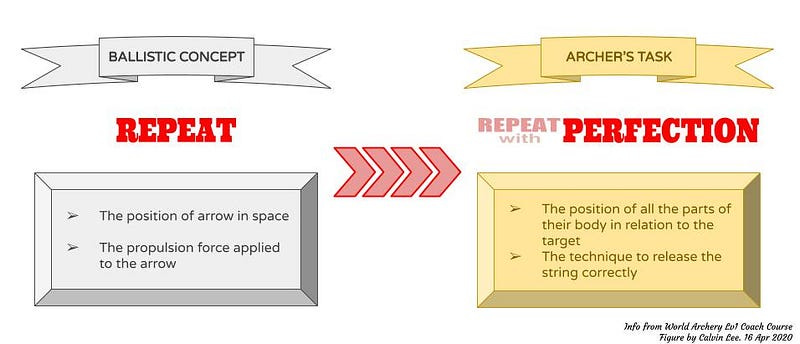
射箭運動的目標很簡單,重複將箭射進靶的黃心,要完成此目標,需要重覆兩點:將箭支放置於空間中相同位置,給序箭支每次一樣的推進能量。為達到上述目標,作為射手的任務則是盡力完美地重覆動作姿勢:身體所有部位相對於目標的位置,鬆弦撒放的正確技術。World Archery Lv1 Coaching Material分析得非常清晰,容許我照抄搬字過紙(圖是自己畫的,字是照抄的):
初學者多以為只要瞄準靶心並及時放箭,即可射中目標,其實這只保證了箭頭的於空間中的位置相同,卻未能確保整支箭的位置相同,要確保箭支的位置一樣必需同時確保箭尾位置相同,而箭尾的位置則受靠弦及頭部位置等整個射箭動作的影響。即使考慮了瞄準時整支箭的位置,仍需要確保供給箭的能量每次一樣,對此有影響的因素很多,包括動作技術例如整個姿勢的感覺、用力的感覺、肌肉的鬆緊度、及身體平衡等,和心理上的感覺例如放鬆、自信、正面及有決心等,全加起來就是整個完成鬆弦撒放的正確技術。
因應需要達到射箭目標的要求,並考慮訓練上的需要,射手需要的元素包括四項:體能、技術、心理、器材。
體能是先決條件,不論初學者或資深射手均不可缺。體能五個項目肌力、耐力、協調、速度及柔韌度,射箭初學者要有足夠肌力才可拉開弓,操控身體肌肉學習正確動作姿勢,無力就無技術,即使擁有知識亦無法控制身體做出正確動作。已接觸運動一段時間的射手需要耐力持續重覆拉弓,同時需要良好體能使身體於訓練後能快速恢複,再次進行訓練並預防受傷。要操控身體精確流暢地執行複雜的射箭動作技術,必需要良好的協調能力。
技術包括基礎射箭動作,亦指訓練的方法,針對比賽需要的技巧策略,應對環境影響外在因素的方法。射箭運動最重要的是完美地重複正確一致的動作,所以絕大部份的訓練及注意力也是放到動作姿勢上。
強大的心理能力確保運動員於高壓比賽環境下能發揮出水準,表現正常甚至超越練習水平,亦支撐運動員應付艱辛的訓練,有系統的專業運動員訓練傾向於初學時已開始加入心理訓練,盡早建立正確心態並訓練心理。心理跟技術一樣有方法訓練,需要培訓,愈高程度運動員心理影響愈大,因大家技術水平、體能及器材的好壞差距並不明顯,而心理強弱最影響臨場表演,決定比賽最終成績分數排名。筆者並非運動心理學專業,相對進行各種心理訓練,個人比較傾向重視心態正面及從正面經驗建築強大心理質素,所以並不準備談及心理,但有一建議建議有興趣可尋找近年本港也開始興起的正念Mindfulness課程一試,除了訓練心理能力外,亦有助加強對自己專項技術的認知、建立並鞏固動作規范。
器材放到四個元素最後,並非表示最不重要,相反不少射手的問題根源為器材選擇或調整失當,只需使用合適器材,並作基本合理預調,即可預防問題產生,可惜礙於資源問題及傳統上不重視器材的錯誤觀念,引發很多根本不應該出現的問題,害了不少初接觸射箭運動的朋友。動作姿勢技術是用於控制拉弓把箭射射,如果弓箭器材預調失當,射手自然需要調整自己身體動作姿勢來補償錯誤,即使能忍受沉悶使用近靶光靶作的動作練習,撒放時弓箭的反應依然會提供射手大量回饋,補償動作或錯誤動作隨時間自然練成。更何況不準初學者瞄靶射分數,只重複枯燥乏味的練習,近乎不可能,亦難以保持射手興趣繼續參與射箭運動,是倒米趕客。
重點
射手的任務是盡力完美地重覆動作姿勢:身體所有部位相對於目標的位置,鬆弦撒放的正確技術;
射手需要的元素包括四項:體能、技術、心理、器材。
By Calvin Lee on April 19, 2020.
Exported from Medium on February 5, 2024.
The Quest for the Gold: What Truly Defines a Precise Archer?
Introductory Note It is a bit of a clickbait title, isn’t it? If a single article could magically solve the mystery of hitting the Gold, archery would lose its charm. However, what exactly must be done to shoot accurately? What are the true requirements for an archer?
The objective of archery is simple: to repeatedly land arrows in the Gold. To achieve this, two conditions must be met consistently: positioning the arrow identically in space for every shot and providing the arrow with the same propulsive energy every time. To fulfill these goals, the archer’s mission is to repeat with perfection the position of all the parts of their body in relation to the target and the technique to release the string correctly. The World Archery Level 1 Coaching Material analyzes this with great clarity; allow me to reference it directly (the diagrams are my own, but the text follows the manual):
Beginners often mistakenly believe that as long as they aim the arrowtip at the center and release on time, they will hit the bullseye. In reality, this only ensures the position of the point in space, failing to ensure the alignment of the entire arrow. To ensure the arrow’s position is identical, the position of the nock must also be consistent. The nock’s position is dictated by the entire shooting motion, including anchor references and head alignment. Even when the arrow’s alignment is accounted for, one must ensure the energy supplied to the arrow is identical every time. Many factors influence this, including technical elements such as the sense and feel of the shooting form, the sensation of force, muscle tension, and body balance, as well as psychological factors like relaxation, confidence, positivity, and determination. Together, these elements constitute the correct technique for a successful release.
To meet the demands of archery and consider training needs, an archer requires four essential elements: Physical Fitness, Technique, Psychology, and Equipment.
Physical Fitness is a prerequisite for both beginners and senior archers. It encompasses five components: strength, endurance, coordination, speed, and flexibility. A beginner must have sufficient strength to draw the bow and control their muscles to learn the correct form; without strength, there is no technique. Even with the knowledge, one cannot command the body to perform correctly without power. Experienced archers require endurance to consistently repeat the draw, as well as the fitness to recover quickly after training and prevent injury. To execute complex shooting techniques precisely and fluidly, excellent coordination is vital.
Technique includes foundational archery movements, training methodologies, competitive strategies, and methods for handling external environmental factors. The most important aspect of archery is the perfect repetition of a correct and consistent motion; therefore, the vast majority of training and focus is placed on form and posture.
Psychology ensures that an athlete can perform at their peak—or even exceed practice levels—under high-pressure competition. It also supports athletes through grueling training. Systematic professional training tends to introduce mental conditioning at the beginner stage to establish the right mindset early on. Like technique, psychology can be trained. For high-level athletes, the psychological gap is the primary decider, as technical, physical, and equipment differences are marginal. While I am not a sports psychology professional, I personally prioritize a positive mindset built on constructive experiences. For those interested, I suggest trying “Mindfulness” courses, which are becoming popular locally. Beyond mental conditioning, mindfulness helps increase awareness of one’s specific technique and helps consolidate standardized movements.
Equipment is listed last, but that does not mean it is the least important. On the contrary, many archers’ problems are rooted in improper equipment choice or tuning. Simply using appropriate gear with a reasonable setup can prevent most issues. Unfortunately, due to resource constraints or a traditional lack of emphasis on equipment, many avoidable problems arise, discouraging those new to the sport. Technique is used to control the bow and shoot the arrow; if the equipment is poorly tuned, the archer will naturally compensate by adjusting their body posture. Even if one endures the boredom of “blank bale” practice (shooting at close range without a target face), the bow’s reaction upon release still provides feedback that can cause compensatory or incorrect habits to set in over time. Furthermore, prohibiting beginners from aiming and forcing them into tedious drills is counterproductive and likely to drive away interest in the sport.
Key Summary Points
The archer’s mission: To repeat with perfection the position of all the parts of their body in relation to the target and the technique to release the string correctly.
The Four Pillars of an Archer: Physical Fitness, Technique, Psychology, and Equipment.